
Photosensitive Epilepsy and Headaches, Migraine: Shared Visual Triggers and How to Manage Them
Key Highlights
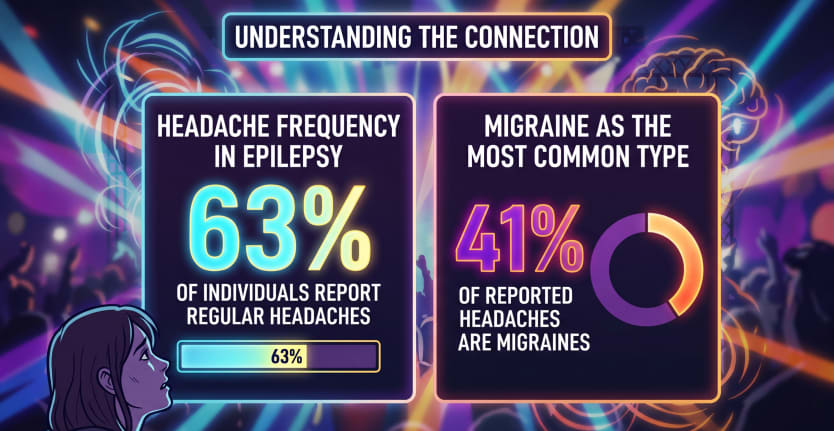
- Headache and epilepsy overlap far more than either condition gets credit for, with roughly 63% of people with epilepsy reporting regular headaches and migraine accounting for the largest share.
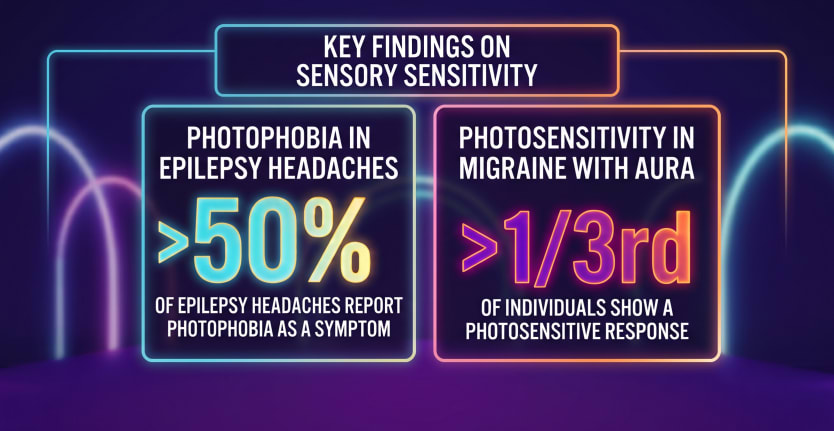
- Light sensitivity sits at the center of both experiences, affecting 80 to 90% of people with migraine during an attack and showing up in more than half of all epilepsy-related headaches.
- The same visual triggers—flicker, glare, high-contrast patterns, and sudden shifts in brightness—can provoke a migraine attack in one brain and a seizure in another.
- Managing your visual environment with precision-tinted eyewear filters the specific wavelengths that provoke a sensitive visual system.
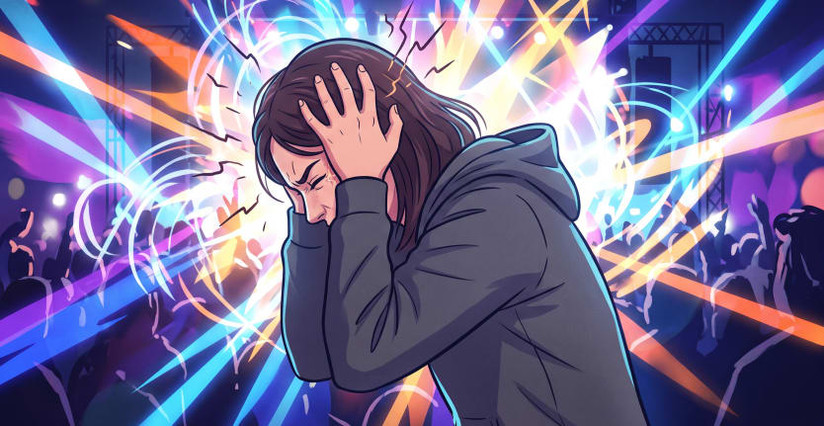
Flashing lights at a concert. The ridged steps of an escalator. Fluorescent tubes humming above a grocery store aisle. For some people, these can set off a seizure. For others, they bring on a migraine attack or another kind of headache episode. And for some, both.
If you live with photosensitive epilepsy and find that headaches are part of the picture too, you aren't imagining the overlap between them. And if you experience migraine attacks and have always felt that flashing lights and bold patterns affect you far more than they seem to affect everyone around you, that instinct is worth taking seriously. Researchers have been documenting the connection between headache disorders and photosensitive epilepsy for decades now, and light and other visual stimuli sit very close to the center of it.
How Often Do Headache and Epilepsy Occur Together?
If you live with epilepsy, headaches may feel like the thing you never quite get around to mentioning, since seizures tend to take up the appointment, the worry, and all of the planning. But headache and epilepsy overlap far more often than either condition really gets credit for.
In one study, roughly 63% of people with epilepsy reported having regular headaches, with migraine the most common type at 41% and tension-type headache next at 14%.1
The relationship goes both ways too.
People with epilepsy are 2.4 times more likely to experience migraine than their own family members who do not have epilepsy.2 That family comparison is what makes the finding so compelling, because it already accounts for the shared genetics and shared environment that parents and siblings have in common. Something about epilepsy itself appears to raise the odds considerably.
Clinicians have been circling this pairing for a very long time. Back in 1960, researchers coined the term "migralepsy" to describe cases where a migraine attack seemed to be followed by seizure activity.3 The term has not aged especially well, and few specialists use it today, but it does show just how long migraine and epilepsy have been understood as genuinely connected rather than merely coincidental.
The Role of Light Sensitivity and Visual Triggers
Light sensitivity is not a minor feature of either condition; it is one of the few experiences that many in both groups share. Known medically as photophobia, this sensitivity affects 80 to 90% of people with migraine during an attack.4 And it shows up in more than half of all epilepsy-related headaches, whether they arrive before a seizure, after one, or in the long stretches between them.5
But light does far more than make an attack that is already underway feel worse. For a great many people, it is what starts the attack in the first place.
Can Light Trigger Both Migraine Attacks and Seizures?
Photosensitive epilepsy is identified by a distinctive pattern in how the brain responds to flickering or other abrasive light. What makes this so relevant to the headache community is that the very same response turns up in people who have migraine and no epilepsy diagnosis at all.
When researchers tested children who experience migraine with aura, that response appeared in more than a third of them, compared with just 1.4% of children without migraine.6 And in a separate group of children who had both migraine and the light-triggered response, light was by far the most common trigger for their attacks.7
There is something telling in the details of photosensitive epilepsy itself, too. It has considerably more in common with migraine than other forms of epilepsy do, sharing the visual symptoms, the accompanying nausea, a higher rate among women, and provocation by both flickering light and bold striped patterns.8
What Are the Visual Triggers of These Conditions?
If you have ever suspected that certain environments are working against you, the research backs you up. The same handful of triggers keeps coming up across both conditions:
- Flicker, whether it comes from fluorescent tubes, digital screens, or sunlight breaking through a row of trees on a drive
- High-contrast patterns
- Glare bouncing off water, snow, or a windshield
- Sudden shifts from a dark room into a bright one
Striped patterns deserve to be singled out here. There is something about a bold, repeating stripe that a sensitive visual system simply cannot settle into—the kind of pattern that makes you want to look away before you have consciously worked out why. Researchers have found that patterns like these cause visual discomfort in most people, headaches in people with migraine, and seizures in people with photosensitive epilepsy.9 It is the same pattern producing three very different outcomes, depending entirely on the brain that happens to be looking at it.
Wavelength appears to matter a great deal as well. Research on migraine has pointed toward shorter wavelengths in the 480 to 520nm range (blue into blue-green) as being especially provoking, while work on visually sensitive seizures has implicated longer wavelengths closer to 580 to 700nm (amber into red).10,11 If you happen to live with both, which range matters more for you is still an open question. What holds either way is that light is never uniform in its effects on a sensitive brain, and that color, not just brightness, plays a real role in shaping the response.
What May Be Happening in the Brain
The leading explanation is that both conditions involve a brain that responds unusually strongly to what it sees. Researchers describe this as altered cortical excitability, which is a technical way of saying that the threshold at which the visual part of the brain fires shifts around more than it does in most people. Photosensitivity is the clearest demonstration of it we have, because the very same flicker that passes unnoticed by nearly everyone else is enough to cross that threshold in a sensitive brain.8
This framing also helps explain something that otherwise seems puzzling. The threshold for a migraine attack appears to sit lower than the threshold for a seizure, which means that a visual trigger is considerably more likely to produce a headache than a seizure.8 And that lines up with what clinicians actually see in practice: people with epilepsy who also have migraine are much more common than people with migraine who also have epilepsy.
If you live with both, visual triggers carry a kind of double uncertainty. The escalator or the flickering tube may cost you a headache, or it may cost you something more serious, and there is usually no way to know which as you walk into it. That ambiguity has a weight of its own, separate from either outcome, and it shapes decisions about where to go and what to risk in a way that neither condition alone quite explains.
Why the Overlap Between Migraine and Photosensitive Epilepsy Isn't Clean
None of this means that migraine and photosensitive epilepsy are the same condition, and the closer we look at them, the more the differences seem to matter.
Part of what makes this overlap so confusing is that migraine and epilepsy behave in remarkably similar ways. Both arrive in episodes, often with a build-up phase, sometimes a set of visual symptoms, then the event itself, and finally an aftermath that can stretch through the rest of the day. People tend to describe the same handful of things in that aftermath, including exhaustion, trouble concentrating, and difficulty finding words.1 And in between episodes, many feel completely fine.
What Is the Difference Between Migraine Aura and a Seizure's Visual Symptoms?
The visual symptoms are where the confusion peaks, and they are also where the two conditions quietly begin to diverge. The differences come down to how quickly the symptoms arrive, how long they last, and what they look like:
- Migraine aura builds slowly, usually over five minutes to an hour, and often spreads across your field of vision as a shifting zigzag.
- Seizure-related visual symptoms come on suddenly, last only seconds to a few minutes, and tend to appear as round or colored shapes confined to one area.1
They may look alike in a summary, but they behave quite differently in practice. Even so, telling them apart from a description alone remains difficult, which is why proper testing and examination during an actual episode tells a clinician far more than your symptom history ever could.

Having the Brain Response Is Not the Same as Having Epilepsy
If you experience migraine attacks and light happens to be one of your triggers, that does not mean you have photosensitive epilepsy, and it does not mean you are on your way to developing it.
On its own, the light-triggered response is fairly common, showing up in a small percentage of perfectly healthy children who never go on to have a seizure of any kind.6 What matters clinically is whether the flickering light produces actual symptoms alongside the brain response, rather than the change appearing by itself.8 A brain that reacts visibly to flicker during a test is simply a brain that is sensitive to flicker, which is genuinely useful information to have about yourself, but it is not a diagnosis.
It also is not strictly a migraine phenomenon. When researchers looked across headache types, that response occurred at broadly similar rates, from roughly 6.7% in tension-type headache to 8.9% in migraine without aura.7 Migraine with aura in younger children does stand out, but visual sensitivity is by no means confined to it.
Can a Migraine Attack Cause a Seizure?
This is one of the most common questions people ask, and the answer is more reassuring than the overlap between these conditions might suggest. A seizure triggered directly by a migraine attack is formally recognized, but only in people who experience migraine with aura, and it is considered rare.12
Its clinical validity is still debated, and many reported cases appear to be misdiagnoses in one direction or the other, with seizures mistaken for migraine attacks or migraine attacks misread as epileptic events.13
How the Two Conditions Behave on Their Own
Interestingly, among people who have both migraine and epilepsy, 84% had attacks that occurred completely independently of one another.14 So while having both conditions is quite common, having one actually set off the other is not. That distinction matters a great deal if you are trying to make sense of your own patterns, because two conditions sharing a body does not mean that every episode has a single explanation, and a headache that arrives during a difficult seizure week is not necessarily connected to it.
There is also a rare situation that runs the other way entirely. Occasionally, headache is not what follows a seizure at all; it is the seizure itself, with no other outward signs. Researchers call this ictal epileptic headache, and it happens almost exclusively in children.8 It remains contested territory, which means that for a parent watching a child endure unexplained and severe head pain, that gap can translate into a very long stretch before anyone thinks to look for it.8
Tips for Managing Light and Visual Triggers
Visual triggers are among the few parts of all this that you can actually do something about. You will not always be able to control where you encounter them, but you can absolutely change how much of it reaches you.
Start by figuring out what your own triggers actually are, because they tend to be far more specific than most trigger lists suggest, and they are deeply personal: a particular aisle at a particular store, one screen but not another, the tiled corridor at your office, a stretch of road at a certain time of day. All of this becomes much easier to spot when you write it down, and a simple log gives you something concrete to bring to your neurologist.
From there, a few practical adjustments are worth trying:
- Replace overhead fluorescents where you can. Lamps and indirect lighting give you far more control over both brightness and flicker.
- Adjust your screens rather than avoiding them. Test out different brightness and color levels, switch on dark mode, and turn off animated or auto-playing content.
- Reduce visual clutter at home. Bold stripes, tight geometric prints, and high-contrast patterns show up in wallpaper, rugs, tile, and bedding more often than you would expect. Softer, lower-contrast surfaces are easier on a sensitive visual system.
- Break up the patterns you cannot remove. Blinds can be tilted or swapped for curtains. Escalator steps and tiled corridors are easier to handle when you look ahead rather than down, or take the stairs or elevator instead.
- Take outdoor glare seriously. Bright days, water, snow, and wet pavement add up quickly, and dark polarized lenses do real work here.
- Keep your doctor in the loop. Seizures, frequent headaches, or any change in either deserve medical attention. A neurologist can look at what is actually happening rather than what a pattern of triggers suggests.
Where Precision-Tinted Glasses Can Help
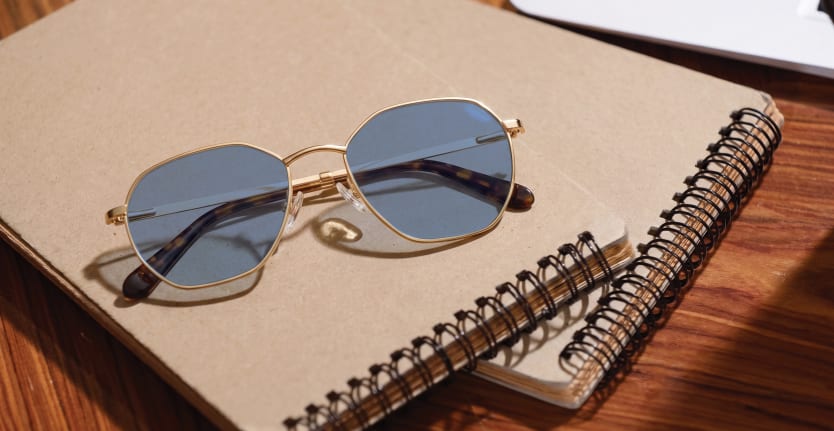
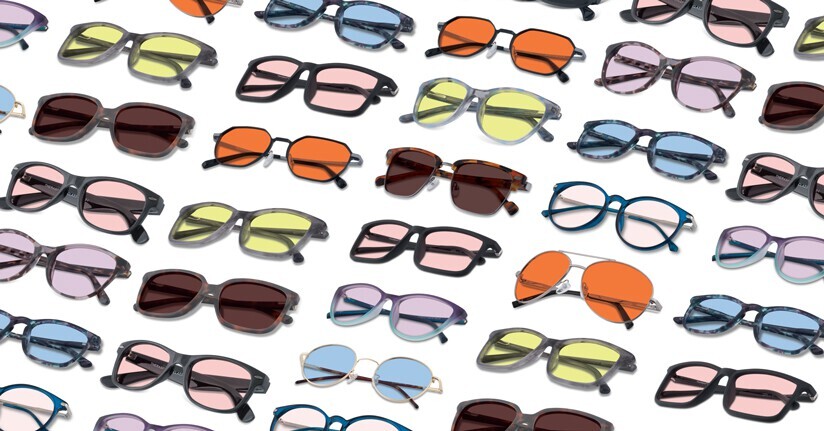
Many people also manage their light exposure by wearing precision-tinted glasses like TheraSpecs, which filter specific wavelengths that have been linked to light and visual sensitivity. Different tints target different parts of the visible spectrum:
- FL-41 tints (FL-Pro, FL-Blend, Flex) filter shorter wavelengths associated with screens and fluorescent lighting
- FL-Sun combines an FL-41 tint with dark, polarized lenses for sunlight and outdoor glare
- Z-Blue targets longer wavelengths and is used in environments with flashing lights and disorienting patterns
Strengths vary within each tint, and prescription and reader options are available across the range. If you are not sure where to start, the lens assistant can point you toward the right option.
There is still a lot researchers are working out about how closely these conditions are connected. But you do not need the full picture to start managing your own visual environment, and every adjustment you make is one less thing working against you.
More Reading: Photosensitivity and Visual Triggers
Flashing Lights and Visually-Sensitive Seizures: Your Questions Answered
Photosensitive Epilepsy: How Light Can Trigger Seizures
Can Striped Patterns Provoke Seizures and Migraine Attacks?
The Best Glasses for Concerts and Other Tips for Sensory Friendly Concert Fun
References:
1 Paungarttner J, Quartana M, Patti L, et al. Migraine, a borderland disease to epilepsy: near it but not of it. J Headache Pain. 2024;25(1):11. doi:10.1186/s10194-024-01719-0
2 Lipton RB, Ottman R, Ehrenberg BL, Hauser WA. Comorbidity of migraine: the connection between migraine and epilepsy. Neurology. 1994;44(10 Suppl 7):S28-S32.
3 Lennox WG, Lennox MA. Epilepsy and Related Disorders. Boston: Little, Brown and Company; 1960.
4 Digre KB, Brennan KC. Shedding light on photophobia. J Neuroophthalmol. 2012;32(1):68-81. doi:10.1097/WNO.0b013e3182474548
5 Syvertsen M, Helde G, Stovner LJ, Brodtkorb E. Headaches add to the burden of epilepsy. J Headache Pain. 2007;8(4):224-230. doi:10.1007/s10194-007-0398-3
6 Piccinelli P, Borgatti R, Nicoli F, et al. Relationship between migraine and epilepsy in pediatric age. Headache. 2006;46(3):413-421. doi:10.1111/j.1526-4610.2006.00373.x
7 Wendorff J, Juchniewicz B. Photosensitivity in children with idiopathic headaches. Neurol Neurochir Pol. 2005;39(4 Suppl 1):S9-S16.
8 Kasteleijn-Nolst Trenité DGA, Verrotti A, Di Fonzo A, et al. Headache, epilepsy and photosensitivity: how are they connected? J Headache Pain. 2010;11(6):469-476. doi:10.1007/s10194-010-0229-9
9 Huang J, Zhu DC. Visually stressful striped patterns alter human visual cortical functional connectivity. Hum Brain Mapp. 2017;38(11):5474-5484. doi:10.1002/hbm.23740
10 Main A, Vlachonikolis I, Dowson A. The wavelength of light causing photophobia in migraine and tension-type headache between attacks. Headache. 2000;40(3):194-199.
11AlDajani BA, Uzair M, Qaiser H, et al. Evaluating the Potential of Light Exposure on Reducing the Frequency of Epileptic Seizures. CNS Neurol Disord Drug Targets. 2024;23(4):463-467. doi:10.2174/1871527322666230407104706
12 Headache Classification Committee of the International Headache Society. The International Classification of Headache Disorders, 3rd edition. Cephalalgia. 2018;38(1):1-211.
13 Pascarella A, Marsico O, Abelardo D, et al. Epilepsy and migraine: a diagnostic and therapeutic challenge. Front Pharmacol. 2025;16:1649543. doi:10.3389/fphar.2025.1649543
14 Marks DA, Ehrenberg BL. Migraine-related seizures in adults with epilepsy, with EEG correlation. Neurology. 1993;43(12):2476-2483.

Last updated 15th Sep 2026
TheraSpecs® Glasses for Light Sensitivity
Find the glasses that fit your needs and lifestyle, and stay protected from screens, fluorescents, unwanted blue light, sunlight, flashing lights, and more.
Shop Now