FAQ: Fluorescent Light Glasses
How do fluorescent light glasses help with fluorescent lighting?
Precision-tinted glasses that are specifically designed for fluorescent lights work by filtering the range of wavelengths that make this kind of lighting so hard on light-sensitive eyes. Not every pair claiming to help manage fluorescent lighting actually does this. Even blue light glasses, which are often marketed for this kind of sensitivity, offer very minimal light filtering and do even less to protect people where it actually matters.
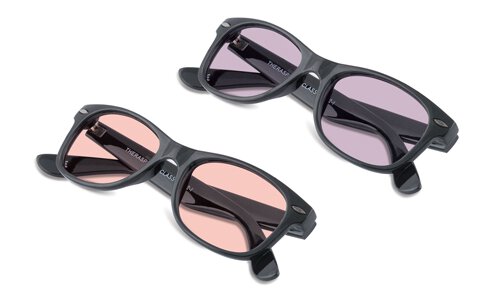
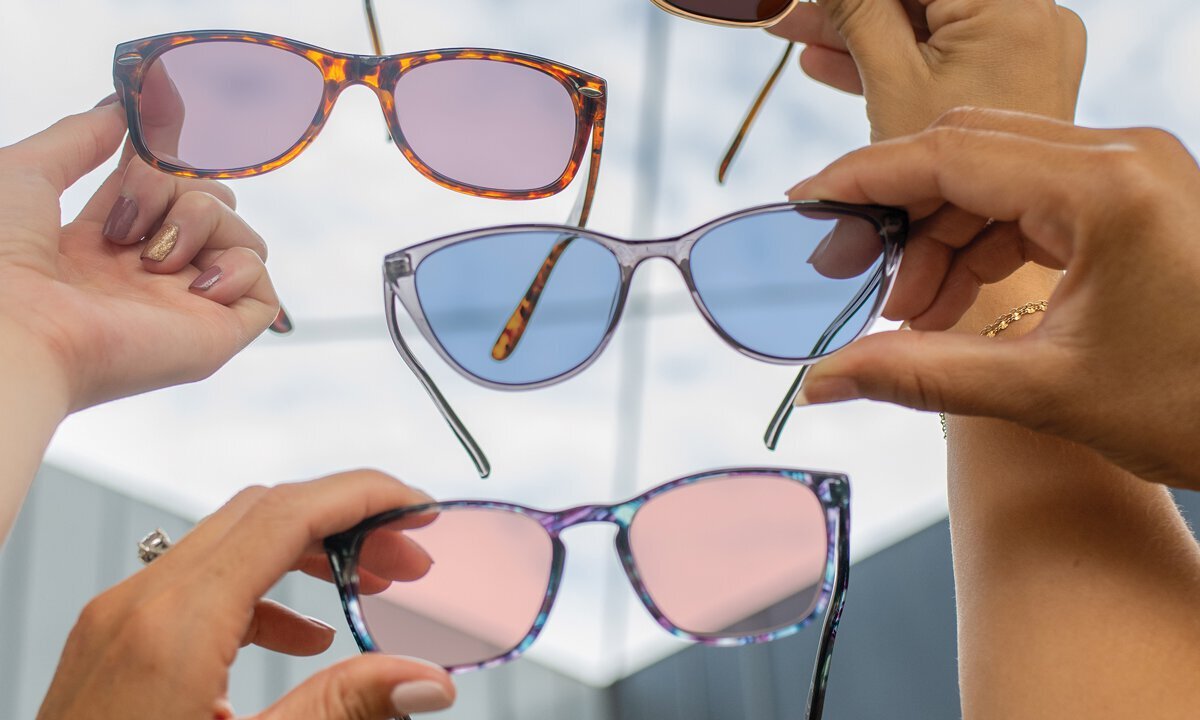
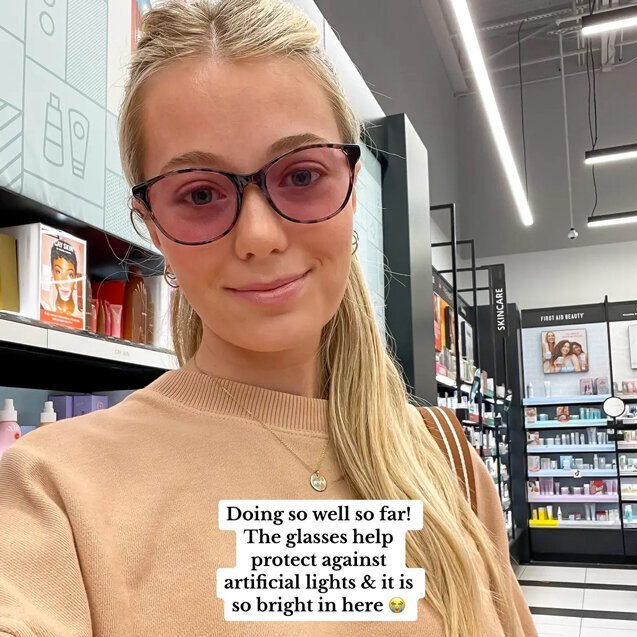
TheraSpecs use a precision FL-41 tint, engineered to filter most strongly between 480 and 520nm, the range where fluorescent light is most irritating and where its invisible pulsing is concentrated. The tint also takes the edge off the overall brightness. Plus, every pair of TheraSpecs blocks 100% of UVA and UVB light and adds an anti-glare coating for more protection, and you can choose from a full catalog of frames, including many with wraparound coverage that will protect you against fluorescents from any direction.
Do fluorescent light glasses help with the flicker?
Yes. Fluorescent tubes pulse rapidly, too fast to consciously see, but the brain still picks up on it. For light-sensitive people that flicker can be just as bothersome as the brightness. The pulsing is concentrated in the same 480 to 520nm range that TheraSpecs filter most heavily, so cutting those wavelengths takes the intensity out of the flicker along with the harshness.
Can these glasses help if my light sensitivity comes from a condition like migraine, autism, or a concussion?
Yes. No matter why you're sensitive, the problem with fluorescent lighting is usually the same: the brightness, the blue-green wavelengths, and the invisible flicker. Sensitive eyes and brains react to those physical properties of the light itself, not to any diagnosis, which is why fluorescents can be tough whether your sensitivity comes from migraine, autism, a concussion, or no known cause at all.
TheraSpecs help you manage your exposure to fluorescent lighting by filtering those problematic wavelengths and easing the intensity of the flicker. Because sensitivities can vary, they come in a range of strengths too, so you can match the level of filtering to what your eyes need.
How are fluorescent light glasses different from regular blue light or computer glasses?
Most blue light and computer glasses have clear or nearly clear lenses that remove only a small percentage of blue light, and mostly in the near-UV range that isn't the main cause of visual discomfort.
TheraSpecs fluorescent light glasses go after the wavelengths that actually bother sensitive eyes, filtering most heavily between 480 and 520nm where fluorescent light is harshest and where its pulsing concentrates. FL-Pro and FL-Blend also filter a significant portion of blue light past that range, more than typical blue light and computer glasses do. That makes them both a more protective option for fluorescents and versatile across a wide range of environments and needs.
Is there a tint that's best for fluorescent light sensitivity?
The tint most often recommended for fluorescent light sensitivity is FL-41. The "FL" stands for "fluorescent," and it was originally developed to ease the discomfort of fluorescent exposure. Rather than a single color, it's a precision tint engineered to filter the 480 to 520nm wavelengths where fluorescent light delivers its most negative effects. That is why it is the top recommendation of neurologists, physical and occupational therapists, and light sensitivity specialists for managing fluorescent lighting.
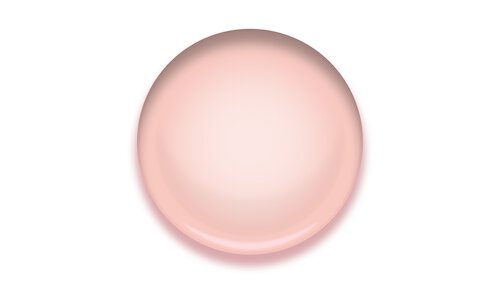
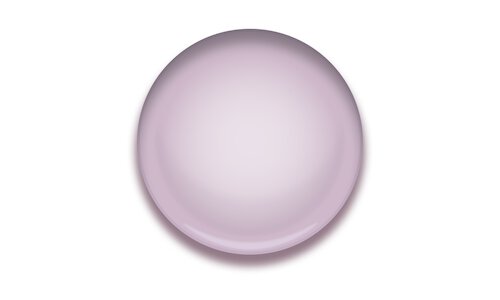
TheraSpecs offers a range of FL-41 options, with two designed specifically to combat fluorescent lighting. FL-Pro provides the strongest filtering, making it the go-to for the brightest or harshest environments, while FL-Blend trades a bit of that filtering for more natural color perception. Both come in multiple strengths, so you can match the level of filtering to how sensitive you are.
If you're not sure where to start, the lens assistant can walk you through a few questions and point you to the option that fits your situation.
Can I just wear sunglasses under fluorescent lights?
Sunglasses aren't the right tool for managing fluorescents over time. Reaching for them may be a common instinct if you're highly sensitive, but they cut brightness across the board without specifically targeting the wavelengths that make fluorescent light irritating. And if worn indoors regularly, dark lenses can also leave the eyes adapting to less light, which can make ordinary light feel harsher afterward.
For fluorescent-lit spaces you're in all day, a lighter, precision-tinted lens is the better choice. TheraSpecs FL-Pro and FL-Blend filter the problematic wavelengths while still letting in enough light for your eyes to stay comfortable, and both come in a range of strengths, so you can step up the filtering without going as dark as sunglasses.
Do fluorescent light glasses also help with screens and LEDs?
Yes. The same wavelengths that make fluorescent lighting so unpleasant are also emitted by digital screens and LED lighting, so glasses that filter that range help across all of them. FL-Pro and FL-Blend are TheraSpecs' most protective lenses for artificial light of any kind, which makes them a practical everyday option if you move between screens, offices, and other indoor environments.
For more specialized situations, TheraSpecs offers other FL-41 options, including dark, polarized FL-Sun sunglasses for bright outdoor light and the Flex lens for night driving. The lens assistant can help you sort out which option best aligns with your needs.
Is there scientific research behind fluorescent light glasses?
Yes, and it goes back decades. Researchers have long studied how fluorescent lighting affects people who are sensitive to it, from the headaches and eye strain it can bring on to the visual stress of its constant, invisible pulsing. That work also pinpointed why fluorescents are so troublesome: much of their most irritating output falls in the blue-green range around 480 to 520nm.
The TheraSpecs team reviewed this body of published, peer-reviewed research to develop a lens catalog that targets these specific wavelengths and provides the right protection against fluorescent light exposure.
That track record bears out in practice, too: for more than a decade, TheraSpecs customers have shared that their glasses make fluorescent-lit spaces easier to handle. In fact, in a survey of light-sensitive customers who had tried both TheraSpecs and general blue light glasses, 78% preferred TheraSpecs (FL-Pro) for handling fluorescent light.5 The lenses are also a top recommendation of neurologists, physical and occupational therapists, and light sensitivity specialists.
Can I get them in my prescription, or wear them over my current glasses?
Yes, both. TheraSpecs lenses can be made with your prescription, either in one of our frames or in a pair you already own and send in. They can also be made as readers if you just need magnification.
If you'd rather keep your current glasses as they are, TheraSpecs offers fitover styles like Original WearOver and Tatum WearOver that sit comfortably over your existing frames, giving you the same fluorescent light filtering without changing your everyday pair.
Fluorescent-lit environments are often described as a nightmare for light-sensitive people. This type of lighting emits harmful wavelengths (480-520nm) that are known to irritate light-sensitive eyes and result in other negative effects like migraine attacks, headaches, dizziness or vertigo, and more.1-3 Since this type of lighting is often bright too, the sheer intensity of it can further impact the fluorescent light sensitivity a person feels in these situations.
Fluorescent lights also pulse faster than we can consciously see but the brain still picks up that pulsing, which many people find distressing, especially if they are already light sensitive. Even for those who may not be sensitive, it can feel disorienting.4
Without a doubt, light management is a critical aspect when it comes to exposure to fluorescent lighting.
TheraSpecs were designed as a way to handle the intensity and harshness of fluorescent lighting. They filter most strongly between 480-520nm, which is where the invisible pulsing is most concentrated, and they minimize the brightness of fluorescents with their specialized tint.
In addition, TheraSpecs are available with ultra-lightweight, flexible frames that also feature enhanced protection designed specifically to protect from fluorescent lighting from all sides.
Both of these lens options also offer excellent protection for screens, LEDs and other artificial light sources.