LED Light Sensitivity Glasses FAQ
How do precision-tinted glasses help with sensitivity to LED lights?
Precision-tinted lenses work by filtering the specific wavelengths that make LED lighting difficult for sensitive eyes, rather than simply dimming everything in view. LEDs emit a high proportion of their output in blue wavelengths, and many of them carry a rapid pulsing that is too fast to consciously see. Glasses that only cut overall brightness leave both of those potential problems intact.
TheraSpecs offers a range of lenses that are tinted to filter most heavily in the ranges tied to visual discomfort and light sensitivity, and each tint targets a different part of the problem, so there are options for overhead LED lighting, screens, and flickering or flashing sources. Every pair blocks 100% of UVA and UVB light, adds an anti-glare coating, and can be paired with frames that block light from above and to the sides.
What tint is recommended for LED light sensitivity?
The tint depends on which LED sources cause the most trouble, and the strength depends on how sensitive you are, how intense the lighting is, and how long you're under it.
FL-Pro and FL-Blend use the FL-41 tint and are the everyday choices for overhead LED lighting and screens. FL-Pro offers the strongest filtering, while FL-Blend balances filtering with a more neutral lens color. Each comes with multiple strength options.
Z-Blue filters red light in the 580 to 640nm range, which addresses the disorienting effect of flashing lights, repeating patterns, and high-contrast stripes rather than general brightness. It comes in Standard, Extra, and Max strength.
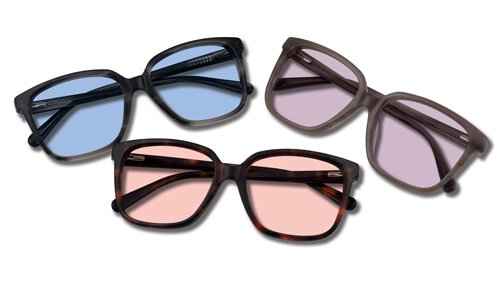
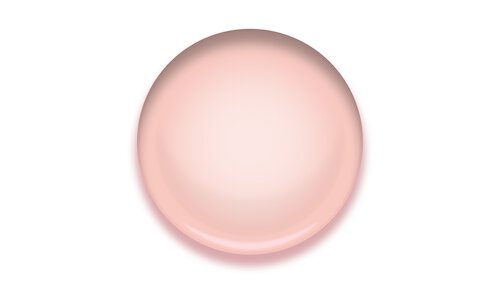
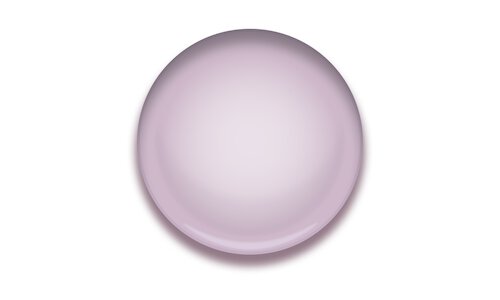
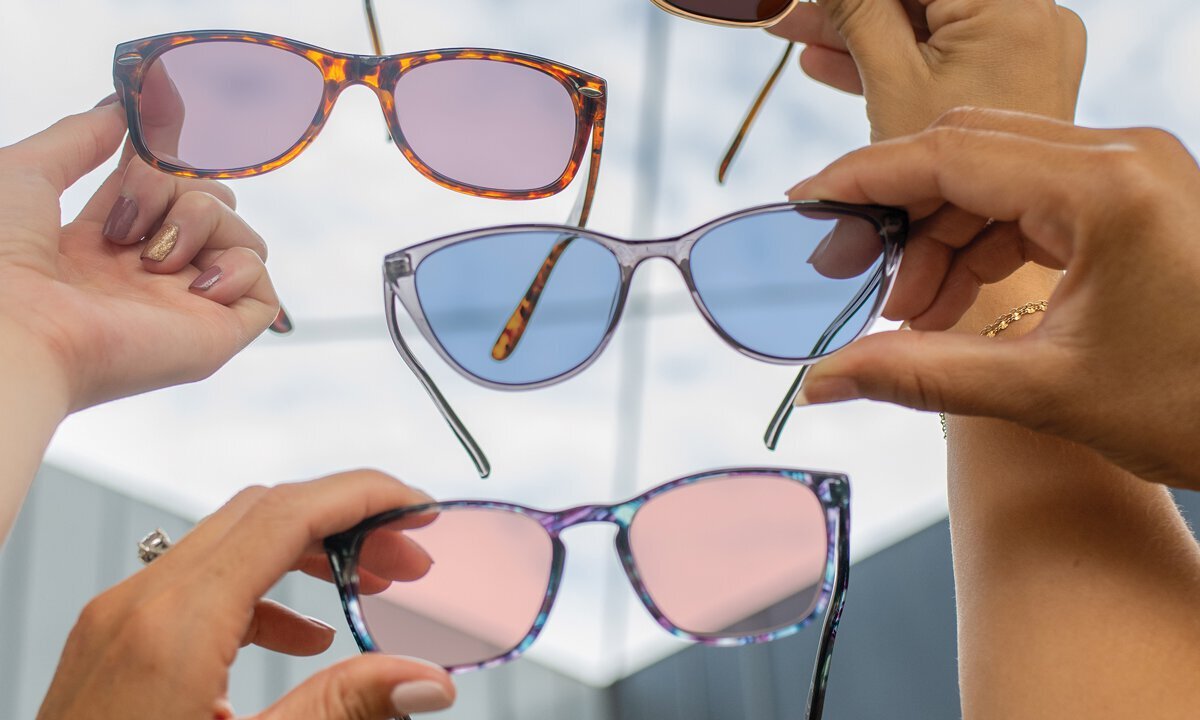
Flex is the lightest tint TheraSpecs offers, in two options, Peach and Lavender. It takes the edge off harsh LED lighting for milder sensitivity, and the subtle tint suits situations where a stronger lens would be too dark or too noticeable, including driving after dark against LED headlights and streetlights.
Strength matters as much as tint. Higher levels of sensitivity and/or more intense environments are where the stronger lenses can earn their place, while color-critical work tends to favor a lighter tint. The lens assistant can help match the right lens and strength to the sources and environments that cause the most difficulty.
How are TheraSpecs LED light sensitivity glasses different from typical blue light glasses?
Most glasses sold as blue light glasses have clear or nearly clear lenses that filter a narrow band in the near-UV and violet range, around 400nm. That is not the part of the spectrum where visual sensitivity originates, and a lens with no visible tint is not removing a meaningful amount of visible light from any range, including blue light.
TheraSpecs filter where LED light actually causes trouble. FL-Pro and FL-Blend do their strongest blue light filtering between 480 and 520nm, the range linked to light sensitivity, while also removing other irritating blue wavelengths. Flex, the lightest lens offered by TheraSpecs, targets that same range in a tint subtle enough for everyday wear. Z-Blue also filters some blue light, but it primarily works further along the spectrum, in the 580 to 640nm range, for the flashing and strobing effects some LEDs produce.
Do TheraSpecs help with LED flicker, including the strobing and flashing you can see?
Yes, though the answer differs depending on which kind you're dealing with.
The invisible pulsing most LEDs produce isn't something a lens can switch off, since the light itself is what cycles. What a precision tint does is reduce how much of that pulsing light gets through. TheraSpecs has several lenses that target the part of the spectrum where LED output is concentrated, which is also where the pulsing is carried, so less of it reaches the eyes. FL-Pro and FL-Blend are the usual choices for the steady overhead LEDs and screens where this comes up.
For flashing and strobing you can actually see, the intensity is higher and the effects can be even more pronounced, so the filtering needs to be able to meet these needs. Z-Blue is the lens most often chosen here, with Extra or Max strength being the best option for those with the highest risk.
Can precision-tinted glasses help with LED headlight and streetlight glare at night?
Yes, and TheraSpecs Flex option is the lens for this situation. It transmits approximately 82% of light, light enough to comply with night driving requirements in most jurisdictions under safe conditions, while still filtering the wavelengths that make LED headlights and streetlights so uncomfortable. Flex comes in two options so the tint can be matched to preference, and it works equally well for passengers, evening walks, and any other after-dark exposure to LED lighting.
If you're a passenger in a car, you can also wear darker lenses (like FL-Pro or FL-Blend) for comfort against headlights.
Can TheraSpecs LED light sensitivity glasses be worn all day, including at work and in front of screens?
Yes. LEDs are everywhere, from overhead lighting to screens, which makes exposure to the irritating wavelengths a constant concern, and the lenses are built for that kind of steady, all-day wear rather than occasional use.
Multiple strength options make that possible. A lighter tint filters the problematic wavelengths while still letting through enough light for a full day indoors, and stronger options are there when the lighting or sensitivity warrants it. Filtering shifts how colors look, and the lighter the tint the less noticeable that is. Flex is the most subtle option, and Standard strengths shift less than Extra or Max.
Frames matter as much as lenses for something worn every day. Styles range from shapes that read as ordinary eyewear to wraparound frames with added coverage above and to the sides, and every pair includes anti-reflective and scratch-resistant coatings. Prescription and reader options are available too, so the glasses can do double duty for anyone who already wears something at their desk.
Is there research on precision-tinted glasses for LED light sensitivity?
Yes. A substantial body of peer-reviewed work has examined how light affects people who are sensitive to it, and much of it points to the same conclusion: brightness alone doesn't explain the problem.
Research has identified the blue-green range around 480-520nm as the part of the visible spectrum producing the strongest response in people who are sensitive to light. LEDs emit a high proportion of these wavelengths, especially cooler color temperatures, and many pulse rapidly when dimmed even slightly, fast enough to be invisible but still detectable by the brain. Flashing and strobing light has been studied separately for its disorienting effects on photosensitive people, distinct from steady light.
The TheraSpecs team reviewed this published research when developing its lens catalog, and each tint targets the specific ranges of LED light that research has shown to be most problematic. This includes several lenses that use FL-41 to filter 480-520nm light, while Z-Blue was created to address the separate body of work on flashing and strobing light for photosensitivity. TheraSpecs are also frequently and consistently recommended by eye doctors, neurologists, and other medical professionals for managing light sensitivity.
Can I get TheraSpecs in my prescription, or wear them over my current glasses?
Yes, both. Our lenses can be made with a prescription, either in a TheraSpecs frame or in a pair sent in through the Send in Your Own Frame option. They can also be made as readers if you just need magnification.
TheraSpecs also offers WearOver styles that sit comfortably over your existing frames, so you can add the tint and protection you need without changing your everyday pair.
LEDs emit high levels of the blue light that research has found to lead to the most intense responses from people who are sensitive to light.1,2 Even people without known light sensitivity can be sensitive to LEDs, particularly those that have a “cool” visual temperature, which are common, especially in public spaces and headlights.3
In addition to the high proportion of blue light wavelengths, LEDs can also have a rapid flicker when dimmed even the slightest amount. While this flicker is too subtle for the eye to see, the brain can still detect it, and can make a light sensitive person feel particularly unwell.4,5
For many, these effects are even more severe than those that result from exposure to dreaded fluorescent lights. In fact, people who are sensitive to light after an accident report greater problems from LED and LCD displays, than they do with fluorescents.6
As a result, creating a light management plan that protects against this regular exposure to LEDs is incredibly important.
Four TheraSpecs options are available to help you manage the problematic wavelengths associated with LED bulbs and sources:
If you experience strong sensitivity to LEDs or are looking for protection from a variety of light sources, we encourage you to try TheraSpecs FL-Pro. This FL-41 lens blocks the highest levels of the problematic wavelengths, including the part of the spectrum where the invisible flicker is most strong, for the most comprehensive protection.*
Shop FL-Pro Lenses ➜
Like FL-Pro, FL-Blend also uses FL-41 to target specific wavelengths of light in LEDs, which can support the management of light sensitivity. The tint is more subtle than FL-Pro to strike a good balance of protection in a less noticeable lens.*
Shop FL-Blend Lenses ➜
*By controlling exposure to LED lighting and the most problematic wavelengths, both FL-Pro and FL-Blend may help people to live well with migraine (including migraine with/without aura, and vestibular migraine, among others), as part of a comprehensive light management program.
We recommend TheraSpecs Z-Blue be added to your wellness plan in order to help manage the visible flicker and/or flashing and strobing of certain LEDs. They also filter other problematic wavelengths, which helps protect in a multitude of lighting situations and environments.
Shop Z-Blue Lenses ➜
If you have mild LED sensitivity or are struggling with LEDs in headlights and streetlights when driving at night, we recommend TheraSpecs Flex. These lenses still target irritating wavelengths and take the edge off bright light, all in lenses light enough to be legal for driving after dark in most jurisdictions under safe conditions.**
Shop Flex Lenses ➜
TheraSpecs are available with ultra-lightweight, flexible frames with styles with extra coverage above and to the sides of the lenses for extra protection from LEDs.